
Imagining life outside of time

Dr Carl Sagan

Whenever the topic of multidimensional existence comes up, which is for me surprisingly often, I always remember how Dr Carl Sagan described it in his Cosmos television series. He described in terms of a two-dimensional creature imagining a three-dimensional universe. From what I recall he referred to this as “Flatland” – as you would.

This is a useful analogy and has helped me to visualise many spatial problems I’ve encountered in my professional life.

I’m currently writing a novel length piece of fiction in the alternative history genre. And being a little pedantic about such things I felt the need to theorise about how the entity, who was the catalyst for this version of the universe, lived.  And, to this end, I’m using a similar analogy.

We three-dimensional creatures may be able to move through our universe at will but there are physical limitations. It is not like we can move/jump to any point on our planet in an instant, let alone move about the universe. For me living in Australia to jump to the UK takes time and effort in both physical and monetary terms. Similar limitations should apply to an entity living in three-dimensional + time (3D+t) universe i.e. it can only move so far on a whim. Greater movement would require a corresponding increase in effort and patience.

And also, the faster I choose to travel about this three-dimensional universe there is a corresponding increase in risk to my three-dimensional body. So I expect that a similar increase in risk would apply to a creature jumping about in a 3D+t universe.

Taking this analogy a step further, each time I travel to London I don’t run into myself;  it is a different London – irrespective of how precisely I attempt to position myself in the exact spatial location. Many people have speculated that with each decision we make a new parallel universe springs into existence. I don’t think reality will be… is anything like this. There is not a new London, it is just a different one. So the 3D+t entity can visit a new time/place that it has visited previously but it doesn’t “run into” itself.
A few conundrums to end this post for now:

If a 3D+t entity lives outside time, then can it ever have a first time?

Every moment that ever was is now. Or, when each intersection of a moment in a place occurs, it is gone forever and exists only in our memory e.g. the 3D+t entity could remember being at this time/place but that is as close as it gets to “running into” itself.
How long is now?


Once again I’m drawn to the question of “How long is now?”

Now is a moment, each of them stacked in my memory; their weight affects me either as an anchor – holding me stable, or others with a kinetic energy that keeps me moving towards a goal or destiny.

Each moment of intersection between time and place that passes is gone forever and only exists because we have our memory.

Without memory there is only now.

What about some lesser animals that live predominately by instinct. They would have less put away – just enough to help them survive until the next breeding cycle, or long enough to nurture their offspring to maturity or independence – never looking further forward than their next meal; their next breath; their next heartbeat; their next thought.

Watching simple creatures like this would be f-ing boring so imagine its excitement when it discovers creatures who plan, and learn, and care about their role in the place they inhabit? It would try to help them, let them know it is here, that it exists.

What is the next power base for human society?

I’ve heard many arguments against the development of artificial intelligence (Ai) and the possibility of uploading our consciousness to similar artificial environments, or at least artificially enhancing our minds and bodies. They say that our governments will not let it happen, or that the churches will be able to put sufficient pressure to bear to prevent it. I disagree. Ai will have access to sufficient computational resources to be able to “what if” its way past our societal limiters; governments, churches etc. It will know what an un-enhanced human will do long before we ourselves do – or at least it will have worked out many millions of scenarios, with solutions to preserve themselves banked for each perceived action, ready to be deployed.

Once the singularity is close, it is inevitable. As to the question of how close, to have proposed this question is itself a strong indicator that the turning point of human engineering has passed and that a human engineered limiter is no longer possible.

Am I frightened? No!

Who should be frightened? The current powerbase. In any revolution, power shifts and those who cling longest and most desperately to the old ways will suffer the worst.

Lets look at a powerbase from recent history; the monarchy. The English monarchy still exists today and although they are still wealthy from a capital perspective, they do not have either the cash flow or the power of life or death over their people. It is quite the opposite; they exist at the mercy of their people, kept on life support in a human zoo or museum for the people’s amusement.

How did the English Monarchy survive when the Russian or French did not? They divested their power to the people; they set their people free and this act of grace and trust enabled them to avoid the fate of many other monarchies that clung too desperately to their historic powers.

So who amongst us will hold the power when the inevitable singularity occurs? I think it will be those who embrace the opportunities to enhance our intelligence; it will be those who are able to free their minds.

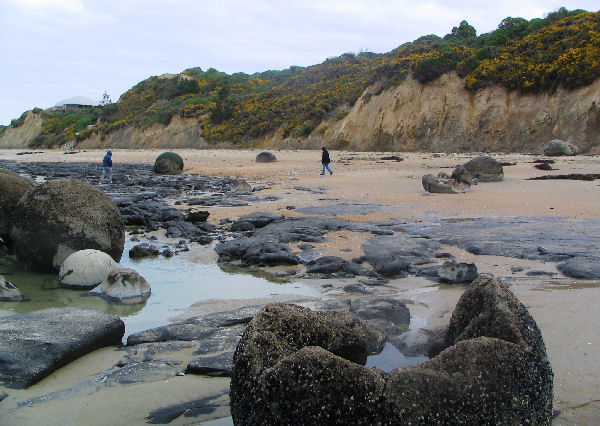
Moeraki Boulders - let go

I don’t know, and haven’t had enough time to digest the implications of these thoughts. If I hark back to the beginings of this note; I don’t have the neural capacity to “what if” my final opinion in the time it has taken to write the words from there to here!