How long is now?


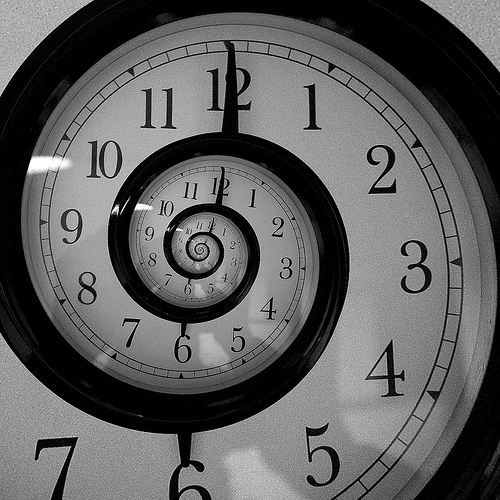
Once again I’m drawn to the question of “How long is now?”

Now is a moment, each of them stacked in my memory; their weight affects me either as an anchor – holding me stable, or others with a kinetic energy that keeps me moving towards a goal or destiny.

Each moment of intersection between time and place that passes is gone forever and only exists because we have our memory.

Without memory there is only now.

What about some lesser animals that live predominately by instinct. They would have less put away – just enough to help them survive until the next breeding cycle, or long enough to nurture their offspring to maturity or independence – never looking further forward than their next meal; their next breath; their next heartbeat; their next thought.

Watching simple creatures like this would be f-ing boring so imagine its excitement when it discovers creatures who plan, and learn, and care about their role in the place they inhabit? It would try to help them, let them know it is here, that it exists.

Who can be my hero?

Yesterday a television commentator, Mia Freedman from the Today Show, decided that it would be a good idea to tell us who we could hold up as heroes.  She has copped a lot of abuse for her short sited and ill informed rant and some of it went well beyond what is acceptable, which I do not condone.

There have been many educated responses too; such as that made by Dr Bridie O’Donnell in an open letter to Mia.

The incident was precipitated by the Australian Cyclist Cadel Evans’ win at the 2011 Tour de France and the outpouring of emotion from his long time supporters and those who tuned in to the coverage in the last week or so.

Cadel Evans is swamped by his BMC teammates after they cross the finish line.

Although I agree that we are occasionally too quick to class some sports people as heroes but having seen the adversity through which Cadel’s victory has emerged from, and knowing firsthand how tough the sport of road cycling is, I certainly classify Cadel as a hero of mine.

Mia’s argument is the same used to play down artistic or creative endeavours as being less than those of scientists and doctors. It is through witnessing the courage of people like Cadel that the world’s “would-be-scientists” keep slogging away at their study and research in the dark hours of the night.

We don’t live for scientific or medical breakthroughs, we strive for them so that humans can live and grow. What is more important – the doctor who saves a few lives or the writer/singer/sportsperson who inspires millions to keep on going even when the circumstances become difficult and the future looks bleak.

Chapeau Cadel!

Never Let Me Go – Discovering your character’s secrets

I read a review with Kazuo Ishiguro from the The Observer (February 2005).  His novel Never Let Me Go has come to the fore again now that it has been made into a movie starring Carry Mulligan, Andrew Garfield and Keira Nightley. 

I was thrilled to read how well he articulated an experience that I’ve also had with my own writing. Below is an excerpt of the interview by Tim Adams of The Observer.


His character “Kathy [H] herself first surfaced in Ishiguro’s notes almost 15 years ago when he had a sense of a book about a group of young people with a seventies atmosphere. ‘They hung around and argued about books,’ he says. ‘I knew there was this strange fate hanging over them, but I couldn’t work out exactly what it was.’ …It was only recently, when he was listening on the radio to various programs about biotechnology, that the particular fate of his sketchy students became clear to him.

I’ve found this happens in my writing too. I wrote a scene over a year ago in which the POV character, Elsie, felt someone watching her and she recognised something about the person’s gait and was sure she would figure out who it was. It wasn’t until last night when I was finally writing the difficult penultimate scene from the chapter that she (we) realised who it was. I’ve tried several time to guess and even removed the comment in one draft because I was so frustrated at not knowing who it was. Sometimes our characters don’t reveal their secrets when we want them to, maybe only when they have to.

I’ve only just finished re-reading  Never Let Me Go and I found it even better the second time around. It is a fascinating book but it could be construed as dangerous; it could lead an unsuspecting mind to places where they either don’t want to go, or cannot escape from.

The movie posters describe it as the “Best Novel of the Decade” and I cannot disagree.

The feature film of the same name, written for the big screen by Alex Garland and directed by Mark Romanek, has been released in the UK and USA and scheduled for release in Australia in March 2011.

Showing what happened is not telling the story

As I’ve mentioned before I have a tendency to say too much and write condescendingly to the reader. Am I trying to show off my knowledge on a subject when it has only a fleeting relevance to the story at hand? 

There is “what happened” and then there is “the story”. If I write only what happened then the story is lost. 

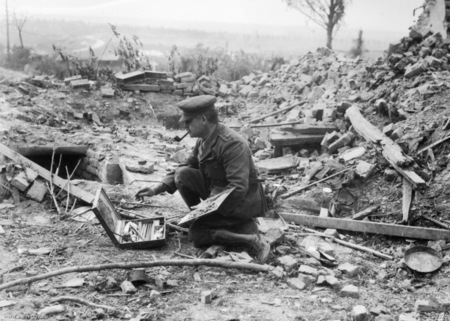
Comparing the two is like comparing the works of the two Australian World War I photographers; George Wilkins and Frank Hurley. Wilkins’ photographs are encyclopedic; bursting with facts and showing the absolute truth. 

Lt James P Quinn


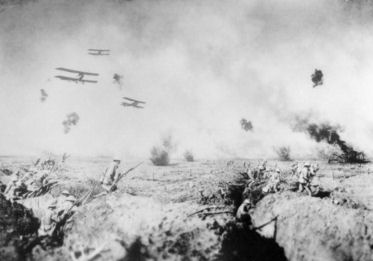
Hurley’s on the other hand were described as “lies” by the pair’s commander Charles Bean (a comment one would expect from a historian). But Hurley’s photographs depict the scene with an intrinsic truth that combines the scene itself with the human mind that perceives it. Hurley used what was at the time referred to as “darkroom tricks” to conjoin several different photographs; using the sky from one photograph with the foreground of trench scene of another. The end result is an image that more truthfully portrayed how the moment was felt by the photographer or the subject. 

Hurley’s photograph “Over the top” depicts Australian soldiers charging from trenches while combat aircraft fly overhead in a sky filled with smoke from shrapnel and bomb explosions. On the picture’s right, smoke issues from a crashed plane. 

Frank Hurley - Over the top

Frank Hurley's Over the top


I need to follow Hurley’s lead in my creative writing and let go of the minute detail; take a step backward and fix myself inside the mind of my characters; and see the scene tainted by their feelings, values, and desires. 

An idea on how to achieve this is to begin by writing what happens; a script almost. This scripting must also include details about how I plan to lead the reader’s mind; setting them up to be surprised; what I’m not telling them. When this plan is clear I can then set aside time each day to retreat into the character’s mind/world and just write –  not having to worry about the larger picture or setup. The plan would include rules such as “don’t mention the war” or “throw in a moment of self-doubt here”.

No-Mind: Do not think about not thinking at all

Thoughts have a power all of their own. Any thought we hold too tightly, or keep too close to our hearts, can have a detrimental effect on our lives.  A thought can become an obsession. For example, a thought that our partner is having an affair develops in our mind, and we filter all of their actions through it, searching for evidence however small. This small thought could develop into an obsession and jealousy and mistrust begins to taint every moment of our lives. Eventually we will see things that are not actually there and over time this will strangle the relationship like weeds in an untended garden.

We should strive to regularly empty our minds lest a thought achieves a foothold that cannot be overcome. Takuan Soho (1573-1645), a Japanese Zen Master and Philosopher from the 1600’s, provided similar advice to his contemporaries whether they were the Shogun, Master Swordsmen, fellow monks or lay members of his community. In a translation of his writings The Unfettered Mind by William Scott Wilson, he said:

If your mind leans in the direction of these thoughts, though you listen, you will not hear; and though you look, you will not see. This is because there is something in your mind. What is there is thought. If you are able to remove this thing…your mind will become No-Mind, it will function when needed, and it will be appropriate to its use.

Unfortunately achieving this state of No-Mind is difficult if not practised regularly. We must make this state, even for a heartbeat, part of our daily lives. But again Takuan warns that this too is a thought: “…the mind that thinks about removing what is in it will, by the very act, be occupied.” He wrote a short poem to help us, and four hundred years later it rings as true as the day he wrote it:

To think, “I will not think.”-

This, too, is something in one’s thoughts.

Simply do not think

about not thinking at all.

Kaligrafia_08

Kaligrafia

Takuan Soho (1573-1645) was a prelate of the Rinsai Sect of Zen, well remembered for his strength of character and acerbic wit; and he was also a gardener, poet, tea master, prolific author and a pivital figure in Zen painting and calligraphy (William Scott Wilson – The Unfettered Mind, 1986).