The Universe…the tyranny of distance and time

I came across this image through erdilielsfavourites‘s blog post “Hubble’s Greatest Hits“, on the twenty-second anniversary of the Hubble Telescope.

The image shows “a delicate cosmic dance is taking place between two galaxies known together as ARP 273. The larger galaxy is an off-kilter spiral, suggesting that the smaller one has actually passed through it. Given the titanic forces that can be released when galaxies merge, these two are lucky to be in the healthy shape they are.” – TIME magazine

Contemplating the physical and temporal scale of the two galaxies passing through each other made me almost physically sick.

I couldn’t help but tink of an intelligent species evolving in some non-distinct solar system and emerging as a star faring civilisation just as the galaxies begin to collide and then wiped out with no hope of escape. There would have been warning too but no chance of survival; not just of one planet lost but entire regions of the galaxy, billions of species lost to the universe.

But then, maybe as a result of the collision, a new species of intelligent life emerges from the shattered star stuff.

It was the same sick, frustrated feeling I remember from a reoccurring dream I had when I was young:

I had to get to the other side of the world to be with someone and travelled there on an ocean liner, taking six months, only to find they’d left to come back to me. I would jump back on the ship but then discover they had done the same. In desperation I would leave a note telling them to stay where they are but then find the same note to me when I arrived.

SS Normandie

SS Normandie (Photo credit: Wikipedia)

Whenever I stayed they did too, and whenever I travelled they would too; always…frustrated by the tyranny of distance and time.

“U” is for the Universe


Looking through the wrong end of a Telescope and other Analogies for Time

We look at the past  through the wrong end of a telescope, he thought one day; eventually the things we can see in there become simply too small to hurt us. (Character: Peter Clayborne) – Kim Stanley Robinson, The Martians Pg. 316

In Kim Stanley Robinson’s Mars series the expected lifespan for humans is extended by a “longevity treatment” to at least several hundred years if not thousands of years. Through this he is able to explore issues and limitations of the human brain for storing and retrieving memories. In one scene, Maya Toitovna is now around 150 years old  has returned to live in a city she had previously lived in 70 or more years before.

Maya found herself trapped in a déjà vu of a déjà vu, Where was she?

It wouldn’t come back to her. It wouldn’t come. A horrible sense of tip-of-the-toungeism made her dizzy, then sick, as if she would get it out by vomiting. She sat down on the steps. On the tip of the tongue, her whole life! Her whole life! She groaned aloud, and some kids throwing pebbles at gulls stared at her.

It hadn’t really been gone; just a momentary lapse in her thinking, while her attention had wandered elsewhere. To another life.

A strong memory had its own integrity, its own dangers, just as much as a weak memory did. It was only the result of thinking that the past was more interesting than the present. Which is many ways was true. But still…

Later Maya saw her daughter Jackie, who she… lets say despised, sailboard on the open oceans of Mars:

Events would soon be washing by her, the way they did everyone else; history was a wave that moved through time slightly faster than an individual life did, so that even when people had lived only to seventy or eighty they had been behind the wave by the time they died; and how much more so now [when they lived for at least several hundred years]. No sailboard would keep you up with that wave… – Kim Stanley Robinson, Blue Mars.

A word of caution here, Maya suffered from severe depression so don’t get drawn too deeply into her neurosis.

“T” is for Time, and for Telescope

Ray Kurzweil…and the singularity

Ray Kurzweil, the Futurist, wrote The Age of Intelligent Machines between 1986 and 1989 and in it he extrapolated existing trends to make many predictions about technology. He predicted that:

by 1998 a computer would beat the world’s best chess player. In fact IBM’s Deep Blue computer beat the World Chess Champion Garry Kasparov.

He also stated that the Internet would explode not only in the number of users but in content as well, eventually granting users access “to international networks of libraries, data bases, and information services”.

Kurzweil wrote that, due to paradigm shifts, a trend of exponential growth will extend Moore’s law from integrated circuits to electromechanical computers. He predicts that the exponential growth will continue, and that in a few decades the computing power of all computers will exceed that of human brains, with superhuman artificial intelligence appearing around the same time.

Moore's Law, The Fifth Paradigm

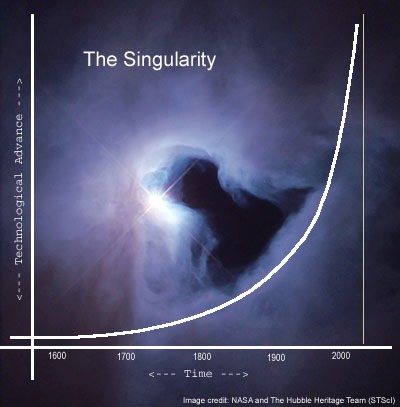
In his most controversial prediction however Kurzweil postulates a law of accelerating return where by the improvements in technology increase exponetially to a point known as the Technological Singularity where the computer, medical, and material technology (nanotechnology) advances to enable artificial intelligence or amplification of human intelligence.

“The Singularity will allow us to transcend these limitations of our biological bodies and brains … There will be no distinction, post-Singularity, between human and machine.” Ray Kurzweil The Singularity is Near pg. 9

I have read many descriptions of the Technological Singularity but the most simple is that at this point artificial intelligence can improve itself faster than humans can and thay will do exactly that, effectivly cutting us out of the loop.

Although many technologists do not support the plausibility of a sudden change such as this, the issue is worthy of study by artificial intelligence reserchers.

R is for Ray Kurzweil – the Futurist

1Q84 – Murakami’s cult masterpiece

Haruki Murakami’s epic novel 1Q84 was an instant success in Japan and soon its publishers were in a mad rush to get the work published for the english language market.

Oddly mirroring the plot line in the novel where one of main characters ghost rewrites a story, the publishers of 1Q84 were in such a hurry to get it to market that they enlisted the services of two different writers to translate the work; one for books I and II, and another for book III.

Set it Japan in 1984 the story revolves around two central characters:

  • Aomame (written with the same characters as the word for “green peas” and pronounced Ah-oh-mah-meh); a female fitness instructor and part-time assassin
  • and Tengo, an aspiring novelist and part time editor and maths lecturer

The point of view alternates each chapter with Aomame and Tengo and the reader slowly learns their connection. Murakami enjoys playing with the time period too and takes his time explaining iconic objects of the time.

1Q84 features an immaculate   conception, telekinesis, transmigrating souls and a talking crow. But the   more blatant oddness of Murakami’s plots tends to distract us from their   roots in emotions that are just as unaccountable. A virtue of his writing is   that, carried away, you rarely sense the strain. – Anthony Cummins The Telegraph UK


Knopf / Getty Images

The title 1Q84 has its roots in a few different places; it is set in 1984, there is of course George Orwell’s novel 1984, and in the story Aomame coins the term for the odd version of the world she finds herself in; it is 1984 but also no longer the same. The name of the letter Q is also the same sound in Japanese as the number nine “Kyu”. And the complexity of this too mirrors that of the storyline in many ways.

…Yes, this is a Haruki Murakami novel, where magical and dreamlike phenomena are deadpanned into existence with the same calm craft that his characters routinely employ in cooking themselves delicious-sounding Japanese meals. – Stephen Poole, The Guardian UK

Murakami has a knack for oddball twists (talking cats, raining fish) and in 1Q84 this continues with terrifying “little people” emerging from the mouths of goats and people and a moss coloured second moon hanging in the sky.

Having Tengo and his editor and co-conspirator discuss the writing and editing process delivers some classic writing advice:

“When you introduce things that readers have never seen before into a piece of fiction, you have to describe them with as much precision and in as much detail as possible. What you eliminate from fiction is the description of things that most readers have seen.”

and on story development:

“Once a gun appears in a story, it will be shot and someone will die”. 

1Q84 is a masterpiece but I am left a little frustrated at having to read the translated story rather than Murakami’s original Japanese work.

Q is for 1Q84 by Haruki Murakami

Paul Dempsey doesn’t write love songs

Paul Dempsey is the front man and singer/songwriter for the Australian rock group Something for Kate (SFK).

His most recent release is the solo album “Everything is true“, on which he played every instrument and provided all the vocals.

“Dempsey is a gifted observer of the human condition…a truly beautiful collection.” – The Daly Telegraph

Dempsey’s songwriting is superb and unique, it stands apart in an industry full of three-minute lust songs.

“The tally for genius lyrics per second is positively baffling…eleven excellent reasons to acquaint yourself with one of Australia’s finest songwriters.”Beat said of his latest solo effort

Dempsey is a veracious reader too and the breadth of his literary consumption appears to feed his songwriting; everything from literary classics, 1960’s Sci-Fi from Philip K Dick, to A Madman Dreams of Turing Machines  by Janna Levin, and The Fabric of the Cosmos by Brian Greene.

“For me…a half a dozen words, the rights words, arranged a certain way…when you get one line that manages to posses some sort of insight into an aspect of your life is so satifying.” PD on Face The Music Songwriting Segment with Paul Dempsey presented by The Push

When asked once about the breadth of subjects in his songs he said that he actively avoids writing love songs, that the genre has been done to death so why put just another love song out there. There are so many more interesting things to write about.

once in a lifetime she says

the waking life stitched together in your head

well, what if it’s only worth

the bundle of nerves it’s written on?

and i don’t need these arms anymore

i don’t need this heart now, to love

i don’t need this skin and bones at all

Ramona was a waitress

Dempsey is currently in the studio recording Something For Kate’s next album, expected to be released later this year.

Paul Dempsey, Stephanie Ashworth, and Clint Hyndman – Something For Kate

“P” is for Paul Dempsey