What is the One Point, hara, or lower dantien?

The one point (also hara or lower dantien) is often explained as the centre of gravity and this is a good start, or “in the ball park” as a Japanese Sensei of mine once joked. But this is only the stepping off point.

For each of us the One Point is the centre of the universe.

The universe is of infinite size and therefore every point in it is also at its centre. Imagine the universe shrinking around you until it is compressed to a single point as inconceivably small as the universe is inconceivably large. This is the One Point, and we can learn to control and use it.

I have found that the One Point becomes the centre of my mind and can be moved about to stabilize myself mentally or physically.

In the West there is a saying “to keep yourself grounded” and this too is a good place to begin, as it too incorporates control of both your physical body and your mind. 

To keep one point is the first of the four basic principles of Aikido (Ki no fudo ho). If we achieve one of these principals, we also achieve the others but if we try to achieve more than one we will not achieve any.

It is as easy to recognise when someone has one point; they are relaxed, happy, centred, balanced, “grounded” and they move without breaking this form, they strike the ball sweetly, throw faster, run effortlessly and always have a light floating feeling. The opposite is also true when we lose one point; our form is bad we bounce around and look to be trying too hard.

If your find you have lost one point, shrink the universe by half and by half until it forms at your centre, and let your mind move there where it too is the centre of the universe.

“O” is for the One Point

No-Form, No thought, No Mind

When we study a new art form we are given forms of movement and told to repeat them endlessly. Our teachers are vigilant and correct our form when we stray but a hair’s breadth.

In Search of Simplicity

As we advance we are given ever more complicated forms to practice, yet we see our teachers break their own rules, seeming to do exactly what we are berated for.

I see shades of Form and No-Form argument in the following passage from Takuan Soho.

The mind that becomes fixed and stops in one place does not function freely. Similarly, the wheels of a cart go around because they are not held rigidly in place. If they were to stick tight, they would not go around. The mind is also something that does not function if it becomes attached to a single situation. – Takuan Soho

One must know the correct form intimately, from the subtle angle of a finger to the large movements of the torso, before we can perceive where to lesson our grip on that form.

You cannot throw the pieces of a cart in a pile and expect to use it as a cart. It must follow the form…but not too rigidly or it becomes a model of a cart—not the real thing itself.

It is the same when we practice any art form, we copy the masters endlessly, searching for those subtitles that belay their importance, hidden many times by large flourishing strokes of the brush or pen.

In the martial arts the form alone is not effective in actual combat.

When one has reached maturity in the art, one will have a formless form. It is like ice dissolving in water. When one has no form, one can be all forms; when one has no style, he can fit in with any style. – Bruce Lee

In a passage from his novel “Musashi“, Eiji Yoshikawa wrote:
Yoshino told Musashi he was rigid and would lose any battle in that state. She cut open her lute to show him how it could produce such varying sounds with only four strings.

It had a central wooden piece that was held in place but not firmly.

“If the cross piece were as taut and unbending as you are, one stroke of the pick would break a string, perhaps even the sounding  board itself.”


Takuan Soho’s writing is infused with wit and multiple levels of meaning. In the following passage he discusses the ‘Mind of No-Mind’ motif.

The mind that thinks about removing what is within it will by the very act be occupied. If one will not think about it, the mind will remove these thoughts by itself and of itself become No-Mind.

If one always approaches the mind in this way, at a later date it will suddenly come to this condition by itself. If one tries to achieve this suddenly, it will never get there.

An old poem says:

To think, “I will not think”—
This, too, is something in one’s thoughts.
Simply do not think
About not thinking at all.

You have got to love that!

“N” is for No-Form, No-Thought, No-Mind

Only describe the extraordinary

Image

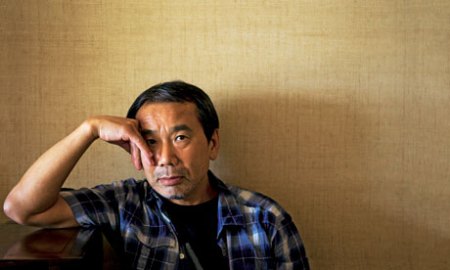
Over the New Year I read a paragraph of Haruki Murakami‘s new novel 1Q84 (pg. 189 HB) and found a wonderful insight to improve my descriptive writing.

An older editor, Komatsu, gave a younger writer some advice on a piece of fiction he was we-writing:

“When you introduce things that readers have never seen before into a piece of fiction, you have to describe them with as much precision and in as much detail as possible. What you eliminate from fiction is the description of things that most readers have seen.”

There is nothing more sure to stop a person reading than if you describe an ordinary scene in a clinical manner. If it is just a room, call it that; a room, and leave the reader to fill in the blanks. But if the room is imperative to the story then describe it through the eyes and tilted perception of the mind of your narrator or character.

I’d love to read a literal translation of Marakami’s original dialogue for his character Kamatsu. Please comment if you find it?