Never Let Me Go – Discovering your character’s secrets

I read a review with Kazuo Ishiguro from the The Observer (February 2005).  His novel Never Let Me Go has come to the fore again now that it has been made into a movie starring Carry Mulligan, Andrew Garfield and Keira Nightley. 

I was thrilled to read how well he articulated an experience that I’ve also had with my own writing. Below is an excerpt of the interview by Tim Adams of The Observer.


His character “Kathy [H] herself first surfaced in Ishiguro’s notes almost 15 years ago when he had a sense of a book about a group of young people with a seventies atmosphere. ‘They hung around and argued about books,’ he says. ‘I knew there was this strange fate hanging over them, but I couldn’t work out exactly what it was.’ …It was only recently, when he was listening on the radio to various programs about biotechnology, that the particular fate of his sketchy students became clear to him.

I’ve found this happens in my writing too. I wrote a scene over a year ago in which the POV character, Elsie, felt someone watching her and she recognised something about the person’s gait and was sure she would figure out who it was. It wasn’t until last night when I was finally writing the difficult penultimate scene from the chapter that she (we) realised who it was. I’ve tried several time to guess and even removed the comment in one draft because I was so frustrated at not knowing who it was. Sometimes our characters don’t reveal their secrets when we want them to, maybe only when they have to.

I’ve only just finished re-reading  Never Let Me Go and I found it even better the second time around. It is a fascinating book but it could be construed as dangerous; it could lead an unsuspecting mind to places where they either don’t want to go, or cannot escape from.

The movie posters describe it as the “Best Novel of the Decade” and I cannot disagree.

The feature film of the same name, written for the big screen by Alex Garland and directed by Mark Romanek, has been released in the UK and USA and scheduled for release in Australia in March 2011.
Showing what happened is not telling the story

As I’ve mentioned before I have a tendency to say too much and write condescendingly to the reader. Am I trying to show off my knowledge on a subject when it has only a fleeting relevance to the story at hand? 

There is “what happened” and then there is “the story”. If I write only what happened then the story is lost. 

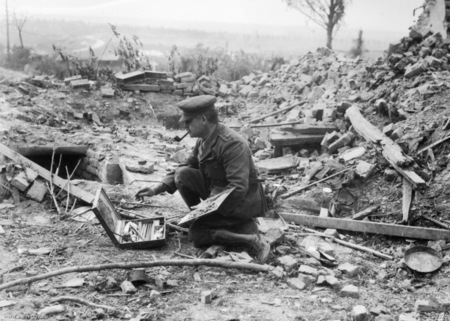
Comparing the two is like comparing the works of the two Australian World War I photographers; George Wilkins and Frank Hurley. Wilkins’ photographs are encyclopedic; bursting with facts and showing the absolute truth. 

Lt James P Quinn


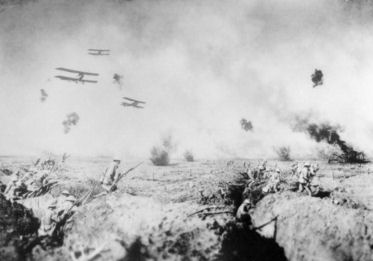
Hurley’s on the other hand were described as “lies” by the pair’s commander Charles Bean (a comment one would expect from a historian). But Hurley’s photographs depict the scene with an intrinsic truth that combines the scene itself with the human mind that perceives it. Hurley used what was at the time referred to as “darkroom tricks” to conjoin several different photographs; using the sky from one photograph with the foreground of trench scene of another. The end result is an image that more truthfully portrayed how the moment was felt by the photographer or the subject. 

Hurley’s photograph “Over the top” depicts Australian soldiers charging from trenches while combat aircraft fly overhead in a sky filled with smoke from shrapnel and bomb explosions. On the picture’s right, smoke issues from a crashed plane. 

Frank Hurley - Over the top

Frank Hurley's Over the top


I need to follow Hurley’s lead in my creative writing and let go of the minute detail; take a step backward and fix myself inside the mind of my characters; and see the scene tainted by their feelings, values, and desires. 

An idea on how to achieve this is to begin by writing what happens; a script almost. This scripting must also include details about how I plan to lead the reader’s mind; setting them up to be surprised; what I’m not telling them. When this plan is clear I can then set aside time each day to retreat into the character’s mind/world and just write –  not having to worry about the larger picture or setup. The plan would include rules such as “don’t mention the war” or “throw in a moment of self-doubt here”.

Branding the literary works of Authorial Groups?

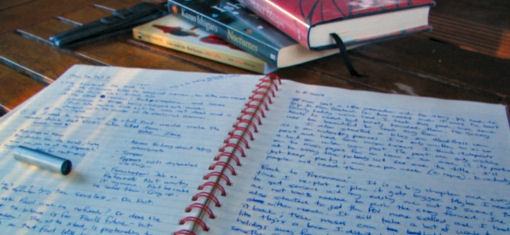
WritingPadAndBooks

Popular music is one of the few creative mediums where branding is used to market the work of a group of artists, The Beatles, U2, or Muse for example. People who have enjoyed previously released work from these groups will often purchase a new release, sight-unseen, because they know and love the “brand” of product the group produces. This branding has been used in other creative mediums. In cinema for example the latest “Tarantino” film is almost guaranteed to be well attended because the viewing public have come to know what to expect in one of his films. In the book industry many author’s work is branded more with the author’s name than with the subject matter of the specific book.

A good percentage of popular music releases over the past half a century have been from groups of artists and this continues to be the case today for two reasons. Firstly, the quality of work that can be produced through a collaborative creative process can be much greater than something produced in isolation, and secondly, that the branding of the product is an immediate and lasting marketing tool. Literary products have not embraced this collaborative approach to the degree that the music industry has. We do see products written jointly by several authors but they are marketed under both author’s names rather than an abstract group name.

Is the literary industry missing out on both counts? …I think they are!

In my “day job” I work collaboratively on creative design tasks and I know from personal experience over the past few decades that I could never have produced designs at anywhere near the quality the group has been able to generate, if I had worked in isolation.

When it comes to writing, I have worked in isolation on a large work of fiction for over a year and although some of the writing is of high quality the project is languishing. A few weeks ago when I first began to contemplate the notion of Authorial Groups I decided to seek out one or more writers to work collaboratively on this project with the object of forming a long term partnership where we could brand our joint literary works. I found this step challenging to take, considering the time and effort I have invested  already in research and writing for the work but I am convinced the end product will be of superior quality and has a better chance of reaching the people I intend it to.

The output from groups can also be higher in quantity due to the number of people focused together at the task of writing. This approach should lead to more regular and reliable releases too, which can only help to build the brand loyalty that will ensure the longevity of the process and the group.

In the same way a band leader, or existing band, will audition for new members I decided to approach a writer to work on a short piece of fiction. This on-the-job task may also help to materialise a collaborative writing process that could work for an authorial group.

So, I’ve engaged with another writer and we’ve agreed to collaborate on a short story to both flesh out the process of literary collaboration and group dynamics in writing.  For example, do we collaborate on the plotting and scene development only and then work independently, or do we continue to write as many fingers at the same keyboard, or simply write the text on a white board and transcribe it at a later date?

Trust is a key factor in any partnership, as well as being strong and confident enough to let your ideas to fall dead to the ground if they are not taken up by the group. Luckily I have worked collaboratively with this writer on other creative projects before and we have often joked about each others crap… sorry…outlandish and impractical ideas. In a way we already know how to work together creatively.

The process has started…

Authorial Groups and Intrinsic Worth; “Collaborwriting”

MirandaChasm

Why don’t we see authorial groups like we do with musical bands? A quick answer could be that performing a musical work often requires a group of musicians while writing is completed in isolation. As artists, writers may be selling their work short by attempting to keep it pure and cleansed of external influences. Of course we are all influenced by other artists work but what I’m suggesting is to collaborate; a process where two or more minds produce something that could never be formed by individual writers working in isolation.

Writing a novel—any writing in fact—is a complex mix of many different processes; plotting, structural design, constructing themes and visions, discovering unique plot twists…it’s never simply putting pen to paper or fingers to keyboard. There’s editing too, and in some situations a good editor can tease out an author’s ideas to produce a work of art that is more intelligible. This is more akin to a record producer who tinkers and cleans, tidying the work as it exists on the page.

Collaborwriting as a group can help to avoid common pitfalls of writing such as a loss of confidence in your ability and becoming overcritical of your work. I know first hand how debilitating these moments can be. Human nature and an environment of trust will ensure we do not become too critical of a collaborative work. Group dynamics can also foster supportive behaviors; lifting members out of their low points and at other times they can stand on each others shoulders to reach heights not possible alone.

A moment of genuine collaborative writing, or “Collaborwriting”, occurs off the page when two minds collide and meld together two form something unique. An early theory about the formation of Miranda, a moon of Uranus, suggested it was formed by the collision of two planetesimal bodies melding to form a single moon. Hugo and Nebula award winning author Kim Stanley Robinson used Miranda’s unique geological history to highlight and suggest the human mind is the integral part of environmental beauty:

After that they hiked down the spine of the buttress in silence. Over the course of the day they descended to Bottoms Landing. Now they were a kilometre below the rims of the chasm, and the sky was a starry band overhead; Uranus fat in the middle of it, the sun a blazing jewel just to one side. Under this gorgeous array the depth of the rift was sublime, astonishing; again Zo felt herself to be flying.

“You’ve located intrinsic worth in the wrong place,” she said to all of them… “It’s like a rainbow. Without an observer at a twenty three degree angle to the light being reflected off a cloud of spherical droplets, there is no rainbow. The whole universe is like that. Our spirits stand at a twenty three degree angle to the universe. There is some new thing created at the contact of photon and retina, some space created between rock and mind. Without mind there is no intrinsic worth.” – Blue Mars (Pages 435-436).

Further illustrating Robinson’s metaphor, the intrinsic beauty of good writing is not contained on the page, that is just ink and paper, and it is not the words and punctuation we craft as writers, it is the thoughts and feelings the writing manifests in the reader’s mind. I’m not suggesting that this higher plane of communication is unachievable when writing in isolation, but that through collaboration we open up possibilities and manifest ideas and concepts that could not be formed by any singular sentient mind.

Augie March put their unique slant on using voice in song lyrics

I’ve never come across such a perfect use of “voice” in music lyrics as on Augie March’s latest album Watch me disappear. I find it especially inspiring for my own writing. I can’t get the voice from track seven, The Slant, out of my head. Musically the song has a light and airy sound but the story is deep and dark. It is sung from the point of view of an early Australian convict on the Island of Tasmania. In his last moments of life, “strung up” and ”A’resting in the rope” he reflects on his life and the purpose and future of ours and his new country’s.

The song ends:

But did they pave the streets of Hobart town?

Lop the old wood forests down?

For the press of King and Crown.

For Honey…? Milk and honey…?

M y a r s e.

It works on so many levels for me and the ending voice still haunts me. It is so angry, disappointed, and resolved to its fate…yet still defiant—offering a final verbal moon at the world.
AlbumCover - website

For more information on the band Augie March see  www.augiemarch.com.au