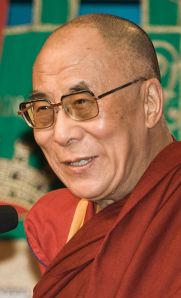
Who was the 15th Dalai Lama?

My faourite quote from the 15th Dalai Lama is:

People object when coerced down a particular path, even if they know it is for the better. It is primeval; they feel trapped and cannot get passed this feeling. You have to make them want to go; make the lead so soft they forget it is there.

PS. FICTION WARINING!!!

The current Dalai Lama (the 14th one) trancends the idea of a religeous leader and is almost an architype to himself. I’m no longer surprised when I come across him as a character in fiction. This by no means denigrates His Holiness, it is because he has touched so many of our lives. The drawers at my writing desk are filled with his quotes and advice on little peices of paper or desk calendar tear offs:

“Sometimes we feel that one individual’s action is very insignificant.  Then we think, of course, that effects should come from channeling or from a unifying movement.  But the movement of the society, community or group of people means joining individuals.  Society means a collection of individuals, so that initiative must come from individuals.  Unless each individual develops a sense of responsibility, the whole community cannot move.  So therefore, it is essential that we should not feel that individual effort is meaningless- you should not feel that way.  We should make an effort.”— His Holiness the Dalai Lama, from ‘The Dalai Lama’s Book of Love and Compassion’, available from Snow Lion Publications.
This quote empowers the individual and comes to my mind whenever I hear people lament their “one” vote or slip into apathy. I keep it close.

The quote at the start of this blog appeared in a short Sci-Fi story I wrote entitled “Panacea” set around the middle of the twentyfirst century. In the story I needed to insert a spiritual element in an attempt to “softly lead” the readers mind to a particular conclusion that I left unsaid at the end of the story.

This fictional Dalai Lama (I remind you of this again) I once desribed to a writer friend as the 14th Dalai Lama on crack. He was less predictable than the 14th Dalai Lama. I felt that if His Holiness had any failing it was that he was so archetypal, so good, and therefore predictable and open to manipulation by subversive groups.

My 15th Dalai Lama never held a gun but he was militant and as Murakami wrote in his book 1Q84:

“Once a gun appears in a story, it will be shot and someone will die”.

D is for the “Dalai Lama”

What is the Beginner’s Mind?

The beginner is blissfully unaware of the pitfalls of this form or that; and so their mind does not stop and they move in a natural way. Unfortunately this beginner’s mind slips from our grasp no matter how much we try to hold on to it and may take years of diligent practice achieve, and for many it is never achieved again.

This could be why many people flitter from one thing to another; at first enthralled by their own extraordinary ability and then blaming one teacher after another for its loss.

When one practices discipline and moves from the beginner’s territory to immovable wisdom, one makes a return and falls back to the level of the beginner. -Takuan Soho

When you study an art, be it martial or otherwise, you are taught diverse ways to move and act; how to hold the sword, racket, bat, or paint brush, and where to put your mind and therefore it stops in many places. Then when you move you are extraordinarily discomforted. After many months and years of training and practice one’s posture or the clinical manner of holding this or that do not weigh heavily on your mind and the mind no longer stops and becomes as it was at the beginning; when you knew nothing and had yet to be taught.

The beginning therefore is the same as the end and is also known as the state of No-Thought-No-Mind. More on that on another day.

Again, we can speak with reference to your own martial art. As the beginner knows nothing about either his body posture or the positioning of his sword, neither does his mind stop anywhere within him. If a man strikes at him with the sword, he simply meets the attack without anything in mind. -Takuan Soho

The mind does not stop he simply meets the attack without anything in mind

“B” is for the Beginner’s Mind

Blogging from A to Z…it’s coming…April 2012

What to expect in April:

Profiles of people who inspire me or I admire

Reviews of books, films, music,…blogs (leave a comment if you would like to feature!)

…and opinion pieces based on a eclectic selection of topics that I find engrossing or alarming

See you on Sunday the first of April

A Fettered Mind

Henry Miller’s Work Schedule

July 1970 with Rip Torn

– Courtesy of Corey Mandell Screenwriting Ramblings

COMMANDMENTS

1. Work on one thing at a time until finished.

2. Start no more new books, add no more new material to “Black Spring.”

3. Don’t be nervous. Work calmly, joyously, recklessly on whatever is in hand.

4 Work according to the program and not according to mood. Stop at the appointed time!

5. When you can’t “create” you can “work.”

6. Cement a little every day, rather than add new fertilizers.

7. Keep human! See people; go places, drink if you feel like it.

8. Don’t be a drought-horse! Work with pleasure only.

9. Discard the Program when you feel like it–but go back to it the next day. CONCENTRATE. NARROW DOWN. EXCLUDE.

10.Forget the books you want to write. Think only of the book you “are” writing.

11 Write first and always. Painting, music, friends, cinema, all these come afterwards.

MILLER’S DAILY PROGRAM

Mornings: If groggy, type notes and allocate, as stimulus. If in fine fettle, write.

Afternoons: Work on section in hand, following plan of section scrupulously. No intrusions, no diversions. Write to finish one section at a time, for good and all.

Evenings: See friends. Read in cafes. Explore unfamiliar sections–on foot if wet, on bicycle if dry. Write, if in mood, but only on Minor program. Paint if empty or tired. Makes Notes. Make Charts, Plans. Make corrections of MS.

Note: Allow sufficient time during daylight to make an occasional visit to museums or an occasional sketch or an occasional bike ride. Sketch in cafes and trains and streets. Cut the movies! Library references once a week.

Why can’t revolutionaries get their people to the end state?

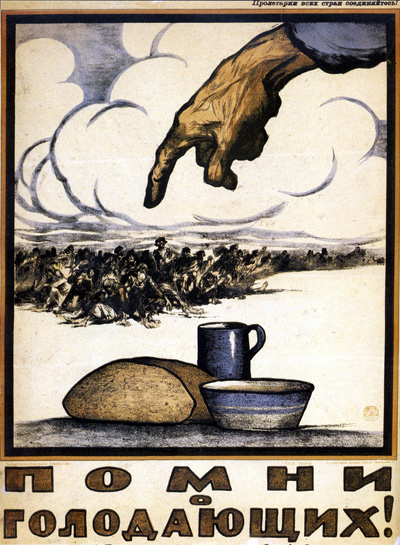
Remember Those Who Starve! - 1921

Remember Those Who Starve! - 1921 Russian Poster by Ivan Simakov (1877-1925). Source: Wikipedia (public domain)

Wilkins was shocked by the devastation inflicted upon the Russian people when he visited there in the 1920’s. In a letter to his friend Yanagita he wrote:

Revolutionaries see only the end state. Their minds are rarely big enough to see how the people they hope to save cannot reach this place alone. They have to be carried. It’s like a parable my father once told me about: how Jesus carried a man through his most difficult times. We have to be the people’s Jesus if we want them to make it safely from where they have been to where we want them to be.