Ray Kurzweil…and the singularity

Ray Kurzweil, the Futurist, wrote The Age of Intelligent Machines between 1986 and 1989 and in it he extrapolated existing trends to make many predictions about technology. He predicted that:

by 1998 a computer would beat the world’s best chess player. In fact IBM’s Deep Blue computer beat the World Chess Champion Garry Kasparov.

He also stated that the Internet would explode not only in the number of users but in content as well, eventually granting users access “to international networks of libraries, data bases, and information services”.

Kurzweil wrote that, due to paradigm shifts, a trend of exponential growth will extend Moore’s law from integrated circuits to electromechanical computers. He predicts that the exponential growth will continue, and that in a few decades the computing power of all computers will exceed that of human brains, with superhuman artificial intelligence appearing around the same time.

Moore's Law, The Fifth Paradigm

In his most controversial prediction however Kurzweil postulates a law of accelerating return where by the improvements in technology increase exponetially to a point known as the Technological Singularity where the computer, medical, and material technology (nanotechnology) advances to enable artificial intelligence or amplification of human intelligence.

“The Singularity will allow us to transcend these limitations of our biological bodies and brains … There will be no distinction, post-Singularity, between human and machine.” Ray Kurzweil The Singularity is Near pg. 9

I have read many descriptions of the Technological Singularity but the most simple is that at this point artificial intelligence can improve itself faster than humans can and thay will do exactly that, effectivly cutting us out of the loop.
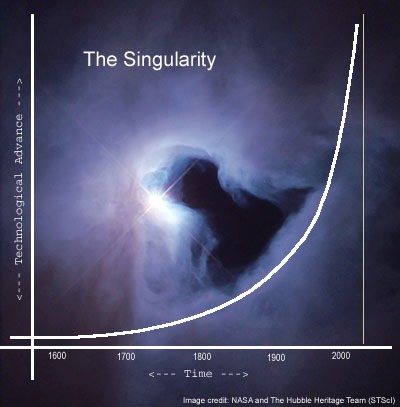
Although many technologists do not support the plausibility of a sudden change such as this, the issue is worthy of study by artificial intelligence reserchers.

R is for Ray Kurzweil – the Futurist

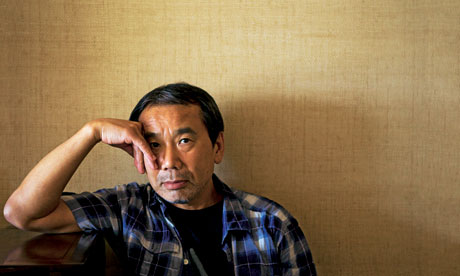
1Q84 – Murakami’s cult masterpiece

Haruki Murakami’s epic novel 1Q84 was an instant success in Japan and soon its publishers were in a mad rush to get the work published for the english language market.

Oddly mirroring the plot line in the novel where one of main characters ghost rewrites a story, the publishers of 1Q84 were in such a hurry to get it to market that they enlisted the services of two different writers to translate the work; one for books I and II, and another for book III.

Set it Japan in 1984 the story revolves around two central characters:

  • Aomame (written with the same characters as the word for “green peas” and pronounced Ah-oh-mah-meh); a female fitness instructor and part-time assassin
  • and Tengo, an aspiring novelist and part time editor and maths lecturer

The point of view alternates each chapter with Aomame and Tengo and the reader slowly learns their connection. Murakami enjoys playing with the time period too and takes his time explaining iconic objects of the time.

1Q84 features an immaculate   conception, telekinesis, transmigrating souls and a talking crow. But the   more blatant oddness of Murakami’s plots tends to distract us from their   roots in emotions that are just as unaccountable. A virtue of his writing is   that, carried away, you rarely sense the strain. – Anthony Cummins The Telegraph UK


Knopf / Getty Images

The title 1Q84 has its roots in a few different places; it is set in 1984, there is of course George Orwell’s novel 1984, and in the story Aomame coins the term for the odd version of the world she finds herself in; it is 1984 but also no longer the same. The name of the letter Q is also the same sound in Japanese as the number nine “Kyu”. And the complexity of this too mirrors that of the storyline in many ways.

…Yes, this is a Haruki Murakami novel, where magical and dreamlike phenomena are deadpanned into existence with the same calm craft that his characters routinely employ in cooking themselves delicious-sounding Japanese meals. – Stephen Poole, The Guardian UK

Murakami has a knack for oddball twists (talking cats, raining fish) and in 1Q84 this continues with terrifying “little people” emerging from the mouths of goats and people and a moss coloured second moon hanging in the sky.

Having Tengo and his editor and co-conspirator discuss the writing and editing process delivers some classic writing advice:

“When you introduce things that readers have never seen before into a piece of fiction, you have to describe them with as much precision and in as much detail as possible. What you eliminate from fiction is the description of things that most readers have seen.”

and on story development:

“Once a gun appears in a story, it will be shot and someone will die”. 

1Q84 is a masterpiece but I am left a little frustrated at having to read the translated story rather than Murakami’s original Japanese work.

Q is for 1Q84 by Haruki Murakami

What is the One Point, hara, or lower dantien?

The one point (also hara or lower dantien) is often explained as the centre of gravity and this is a good start, or “in the ball park” as a Japanese Sensei of mine once joked. But this is only the stepping off point.

For each of us the One Point is the centre of the universe.

The universe is of infinite size and therefore every point in it is also at its centre. Imagine the universe shrinking around you until it is compressed to a single point as inconceivably small as the universe is inconceivably large. This is the One Point, and we can learn to control and use it.

I have found that the One Point becomes the centre of my mind and can be moved about to stabilize myself mentally or physically.

In the West there is a saying “to keep yourself grounded” and this too is a good place to begin, as it too incorporates control of both your physical body and your mind. 

To keep one point is the first of the four basic principles of Aikido (Ki no fudo ho). If we achieve one of these principals, we also achieve the others but if we try to achieve more than one we will not achieve any.

It is as easy to recognise when someone has one point; they are relaxed, happy, centred, balanced, “grounded” and they move without breaking this form, they strike the ball sweetly, throw faster, run effortlessly and always have a light floating feeling. The opposite is also true when we lose one point; our form is bad we bounce around and look to be trying too hard.

If your find you have lost one point, shrink the universe by half and by half until it forms at your centre, and let your mind move there where it too is the centre of the universe.

“O” is for the One Point

No-Form, No thought, No Mind

When we study a new art form we are given forms of movement and told to repeat them endlessly. Our teachers are vigilant and correct our form when we stray but a hair’s breadth.

In Search of Simplicity

As we advance we are given ever more complicated forms to practice, yet we see our teachers break their own rules, seeming to do exactly what we are berated for.

I see shades of Form and No-Form argument in the following passage from Takuan Soho.

The mind that becomes fixed and stops in one place does not function freely. Similarly, the wheels of a cart go around because they are not held rigidly in place. If they were to stick tight, they would not go around. The mind is also something that does not function if it becomes attached to a single situation. – Takuan Soho

One must know the correct form intimately, from the subtle angle of a finger to the large movements of the torso, before we can perceive where to lesson our grip on that form.

You cannot throw the pieces of a cart in a pile and expect to use it as a cart. It must follow the form…but not too rigidly or it becomes a model of a cart—not the real thing itself.

It is the same when we practice any art form, we copy the masters endlessly, searching for those subtitles that belay their importance, hidden many times by large flourishing strokes of the brush or pen.

In the martial arts the form alone is not effective in actual combat.

When one has reached maturity in the art, one will have a formless form. It is like ice dissolving in water. When one has no form, one can be all forms; when one has no style, he can fit in with any style. – Bruce Lee

In a passage from his novel “Musashi“, Eiji Yoshikawa wrote:
Yoshino told Musashi he was rigid and would lose any battle in that state. She cut open her lute to show him how it could produce such varying sounds with only four strings.

It had a central wooden piece that was held in place but not firmly.

“If the cross piece were as taut and unbending as you are, one stroke of the pick would break a string, perhaps even the sounding  board itself.”


Takuan Soho’s writing is infused with wit and multiple levels of meaning. In the following passage he discusses the ‘Mind of No-Mind’ motif.

The mind that thinks about removing what is within it will by the very act be occupied. If one will not think about it, the mind will remove these thoughts by itself and of itself become No-Mind.

If one always approaches the mind in this way, at a later date it will suddenly come to this condition by itself. If one tries to achieve this suddenly, it will never get there.

An old poem says:

To think, “I will not think”—
This, too, is something in one’s thoughts.
Simply do not think
About not thinking at all.

You have got to love that!

“N” is for No-Form, No-Thought, No-Mind

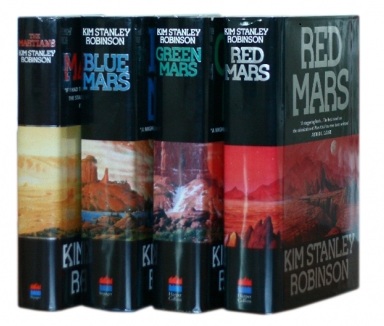
The Mars Series by Kim Stanley Robinson

Although Kim Stanley Robinson’s award-winning Mars Series , written in 1992, has been criticised for some failings for forsight, such as the exclusion of China from the multinational venture, and the larger than expected role of the Russian team following the real world collapse of the USSR. However, twenty years on the story does not feel dated as many other science fiction titles do.

The three original three volumes, Red, Blue, and Green Mars received acclaim (Nebula, Hugo, and BSFA awards) from both within and without the science fiction genre, and like the Apollo missions of NASA in the 1960’s this story of the colonisation and terraforming of Mars has inspired a new generation of scientists and philosophers to look towards our neighboring red planet with longing eyes and big dreams.

The Mars Series tells the story of the first one hundred humans to permanently settle on Mars.

It is the red planet itself though that drives the story forward, as both a character and the sense of “place” it provides.

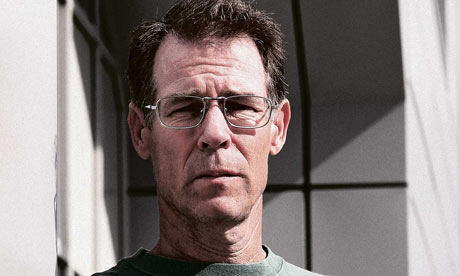
Kim Stanley Robinson: science fiction's realist - The Guardian UK

Red Mars, the first book in the series, begins with a speach given by John Boone, the default leader of the multinational venture and “the first man on Mars”, at the opening of the first “tented” city of Nicosia. But then moves back to the selection of the first one hundred team on earth and then the departure of the Ares of the from earth orbit where it had been constructed.

The series contains all the admirable tropes of the science fiction genre but it is no “Space Opera” and it has received some negative criticism from with the genre because of this. It was with this series that new sub-genre of science fiction was coined; Future History. It reads like a novelisation of well known historic events rather than pure invention and this only enhances it realism.

In addition to the red planet itself as the driving force of the story, it is the extraordinarily detailed characters that stay with you. The structure of the books, particularly the narrative mode of third person subjective, lends itself to this end with the POV set with the one character for each chapter. Robinson’s writing is of such high quality that the reader cannot help but sympathies with these POV characters even when they could be considered antagonists.

I always feel a sense of loss when one chapter ends and I am summarily evicted from inside the head of the POV character who led the chapter. But this loss is more than balanced by the welcoming feeling when returning to a POV character that I’ve come to know intimately.

In 2012, the twentieth anniversary of the release of Red Mars, the series reads as fresh and thought provoking as it did when first published.

Kim Stanley Robinson’s latest work 2312 is due for release in late May 2012. Orbit publisher Tim Holman described the setting of this novel thusly:

2312 will be set in our solar system three hundred years from now; a solar system in which mankind has left Earth and found new habitats. This will be a novel for anyone curious to see what our future looks like – a grand science-fictional adventure in every sense.

It is number one on my list of recommended reads for both readers of SCI FI and fiction in general.

“M” is for the Mars Series