Paul Dempsey doesn’t write love songs

Paul Dempsey is the front man and singer/songwriter for the Australian rock group Something for Kate (SFK).

His most recent release is the solo album “Everything is true“, on which he played every instrument and provided all the vocals.

“Dempsey is a gifted observer of the human condition…a truly beautiful collection.” – The Daly Telegraph

Dempsey’s songwriting is superb and unique, it stands apart in an industry full of three-minute lust songs.

“The tally for genius lyrics per second is positively baffling…eleven excellent reasons to acquaint yourself with one of Australia’s finest songwriters.”Beat said of his latest solo effort

Dempsey is a veracious reader too and the breadth of his literary consumption appears to feed his songwriting; everything from literary classics, 1960’s Sci-Fi from Philip K Dick, to A Madman Dreams of Turing Machines  by Janna Levin, and The Fabric of the Cosmos by Brian Greene.

“For me…a half a dozen words, the rights words, arranged a certain way…when you get one line that manages to posses some sort of insight into an aspect of your life is so satifying.” PD on Face The Music Songwriting Segment with Paul Dempsey presented by The Push

When asked once about the breadth of subjects in his songs he said that he actively avoids writing love songs, that the genre has been done to death so why put just another love song out there. There are so many more interesting things to write about.

once in a lifetime she says

the waking life stitched together in your head

well, what if it’s only worth

the bundle of nerves it’s written on?

and i don’t need these arms anymore

i don’t need this heart now, to love

i don’t need this skin and bones at all

Ramona was a waitress

Dempsey is currently in the studio recording Something For Kate’s next album, expected to be released later this year.

Paul Dempsey, Stephanie Ashworth, and Clint Hyndman – Something For Kate

“P” is for Paul Dempsey

What is the One Point, hara, or lower dantien?

The one point (also hara or lower dantien) is often explained as the centre of gravity and this is a good start, or “in the ball park” as a Japanese Sensei of mine once joked. But this is only the stepping off point.

For each of us the One Point is the centre of the universe.

The universe is of infinite size and therefore every point in it is also at its centre. Imagine the universe shrinking around you until it is compressed to a single point as inconceivably small as the universe is inconceivably large. This is the One Point, and we can learn to control and use it.

I have found that the One Point becomes the centre of my mind and can be moved about to stabilize myself mentally or physically.

In the West there is a saying “to keep yourself grounded” and this too is a good place to begin, as it too incorporates control of both your physical body and your mind. 

To keep one point is the first of the four basic principles of Aikido (Ki no fudo ho). If we achieve one of these principals, we also achieve the others but if we try to achieve more than one we will not achieve any.

It is as easy to recognise when someone has one point; they are relaxed, happy, centred, balanced, “grounded” and they move without breaking this form, they strike the ball sweetly, throw faster, run effortlessly and always have a light floating feeling. The opposite is also true when we lose one point; our form is bad we bounce around and look to be trying too hard.

If your find you have lost one point, shrink the universe by half and by half until it forms at your centre, and let your mind move there where it too is the centre of the universe.

“O” is for the One Point

No-Form, No thought, No Mind

When we study a new art form we are given forms of movement and told to repeat them endlessly. Our teachers are vigilant and correct our form when we stray but a hair’s breadth.

In Search of Simplicity

As we advance we are given ever more complicated forms to practice, yet we see our teachers break their own rules, seeming to do exactly what we are berated for.

I see shades of Form and No-Form argument in the following passage from Takuan Soho.

The mind that becomes fixed and stops in one place does not function freely. Similarly, the wheels of a cart go around because they are not held rigidly in place. If they were to stick tight, they would not go around. The mind is also something that does not function if it becomes attached to a single situation. – Takuan Soho

One must know the correct form intimately, from the subtle angle of a finger to the large movements of the torso, before we can perceive where to lesson our grip on that form.

You cannot throw the pieces of a cart in a pile and expect to use it as a cart. It must follow the form…but not too rigidly or it becomes a model of a cart—not the real thing itself.

It is the same when we practice any art form, we copy the masters endlessly, searching for those subtitles that belay their importance, hidden many times by large flourishing strokes of the brush or pen.

In the martial arts the form alone is not effective in actual combat.

When one has reached maturity in the art, one will have a formless form. It is like ice dissolving in water. When one has no form, one can be all forms; when one has no style, he can fit in with any style. – Bruce Lee

In a passage from his novel “Musashi“, Eiji Yoshikawa wrote:

Yoshino told Musashi he was rigid and would lose any battle in that state. She cut open her lute to show him how it could produce such varying sounds with only four strings.

It had a central wooden piece that was held in place but not firmly.

“If the cross piece were as taut and unbending as you are, one stroke of the pick would break a string, perhaps even the sounding  board itself.”


Takuan Soho’s writing is infused with wit and multiple levels of meaning. In the following passage he discusses the ‘Mind of No-Mind’ motif.

The mind that thinks about removing what is within it will by the very act be occupied. If one will not think about it, the mind will remove these thoughts by itself and of itself become No-Mind.

If one always approaches the mind in this way, at a later date it will suddenly come to this condition by itself. If one tries to achieve this suddenly, it will never get there.

An old poem says:

To think, “I will not think”—
This, too, is something in one’s thoughts.
Simply do not think
About not thinking at all.

You have got to love that!

“N” is for No-Form, No-Thought, No-Mind

The Mars Series by Kim Stanley Robinson

Although Kim Stanley Robinson’s award-winning Mars Series , written in 1992, has been criticised for some failings for forsight, such as the exclusion of China from the multinational venture, and the larger than expected role of the Russian team following the real world collapse of the USSR. However, twenty years on the story does not feel dated as many other science fiction titles do.

The three original three volumes, Red, Blue, and Green Mars received acclaim (Nebula, Hugo, and BSFA awards) from both within and without the science fiction genre, and like the Apollo missions of NASA in the 1960’s this story of the colonisation and terraforming of Mars has inspired a new generation of scientists and philosophers to look towards our neighboring red planet with longing eyes and big dreams.

The Mars Series tells the story of the first one hundred humans to permanently settle on Mars.

It is the red planet itself though that drives the story forward, as both a character and the sense of “place” it provides.

Kim Stanley Robinson: science fiction's realist - The Guardian UK

Red Mars, the first book in the series, begins with a speach given by John Boone, the default leader of the multinational venture and “the first man on Mars”, at the opening of the first “tented” city of Nicosia. But then moves back to the selection of the first one hundred team on earth and then the departure of the Ares of the from earth orbit where it had been constructed.

The series contains all the admirable tropes of the science fiction genre but it is no “Space Opera” and it has received some negative criticism from with the genre because of this. It was with this series that new sub-genre of science fiction was coined; Future History. It reads like a novelisation of well known historic events rather than pure invention and this only enhances it realism.

In addition to the red planet itself as the driving force of the story, it is the extraordinarily detailed characters that stay with you. The structure of the books, particularly the narrative mode of third person subjective, lends itself to this end with the POV set with the one character for each chapter. Robinson’s writing is of such high quality that the reader cannot help but sympathies with these POV characters even when they could be considered antagonists.

I always feel a sense of loss when one chapter ends and I am summarily evicted from inside the head of the POV character who led the chapter. But this loss is more than balanced by the welcoming feeling when returning to a POV character that I’ve come to know intimately.

In 2012, the twentieth anniversary of the release of Red Mars, the series reads as fresh and thought provoking as it did when first published.

Kim Stanley Robinson’s latest work 2312 is due for release in late May 2012. Orbit publisher Tim Holman described the setting of this novel thusly:

2312 will be set in our solar system three hundred years from now; a solar system in which mankind has left Earth and found new habitats. This will be a novel for anyone curious to see what our future looks like – a grand science-fictional adventure in every sense.

It is number one on my list of recommended reads for both readers of SCI FI and fiction in general.

“M” is for the Mars Series

Learning…the teacher must learn the most

Today’s post is a cacophony of snip-its and quotes about learning and teaching.

From “The Years of Rice and Salt” by Kim Stanley Robinson

It is always the teacher who must learn the most, Bistami thought, or else nothing real has happened in the exchange.  Pg. 130

The word of God came down to man as rain to soil, and the result was mud, not clear water. (Bistami) Pg. 128

US edition coverFrom “Musashi” by Eiji Yoshikawa

At times like this, the world, which he once thought so full of stupid people, seemed frighteningly large. Pg. 472

After this experience, he realised how premature his judgement had been and how importent and useful randomly acquired bits of knowledge could subsequently be.Pg. 362

– I must have subconsciously picked this lesson up from a previous reading, or another source, as it is one of the items of advice I included in a conference presentation in 2002: “Listen to everything, try and understand everything, see everything. Time is only wasted if you do not listen. One day this knowledge will be useful in ways you do not expect.”

From “The Lone Samurai – the life of Myamoto Musashi” by William Scott Wilson

…the principles of swordsmanship must be understood as though the student himself had discovered them. This was a major departure from other sword styles of Musashi’s time.

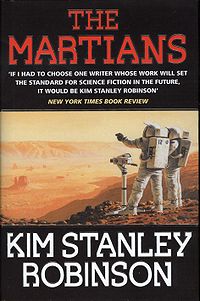
From “The Martians” by Kim Stanley Robinson

Imbition is the tendency of granular rock to imbibe a fluid under the force of capillary attraction, in the absence of any pressure. Sax became convinced that this was a quality of mind as well. He would say of someone, “She has great imbition.” and people would say “Ambition?” and he would reply, “No imbition.” And because of his stroke people would assume he was just having speech trouble again. Pg. 337

From Quotes:

If you’re more relaxed I think your brain functions more effectively. Tibetans, generally speaking, are quite jovial. In my family we were always laughing. – Dalai Lama

Minds are like parachutes; they work best when open. – Lord Thomas Dewar

You must sit in a chair for a very long time, with your mouth open, before roast duck flies in. Chinese Proverb

If you are standing on the shoulders of giants, modesty is not only pointless, it is disrespectful.

Don’t limit a child to your own learning for they were born in another time. – Rabbinical saying

Teching in a martial art is a great place to learn the art of teaching (and learning), “there is nowhere to hide on the mat”, but the princples can be applied to any situation be it a business meeting, talking with your children, or writing a story/magizine article.

I have found that when most people teach or talk it is a one directional act. People immediately put up walls in their minds, even if they know the information is something they need to understand; it is primeval. You have to set up the environment so that they decide to draw the information in, then as a teacher you don’t force it on to them or spoon feed them, you just put the knowledge out there to be imbibed by their now open minds.

“L” is for Learning